
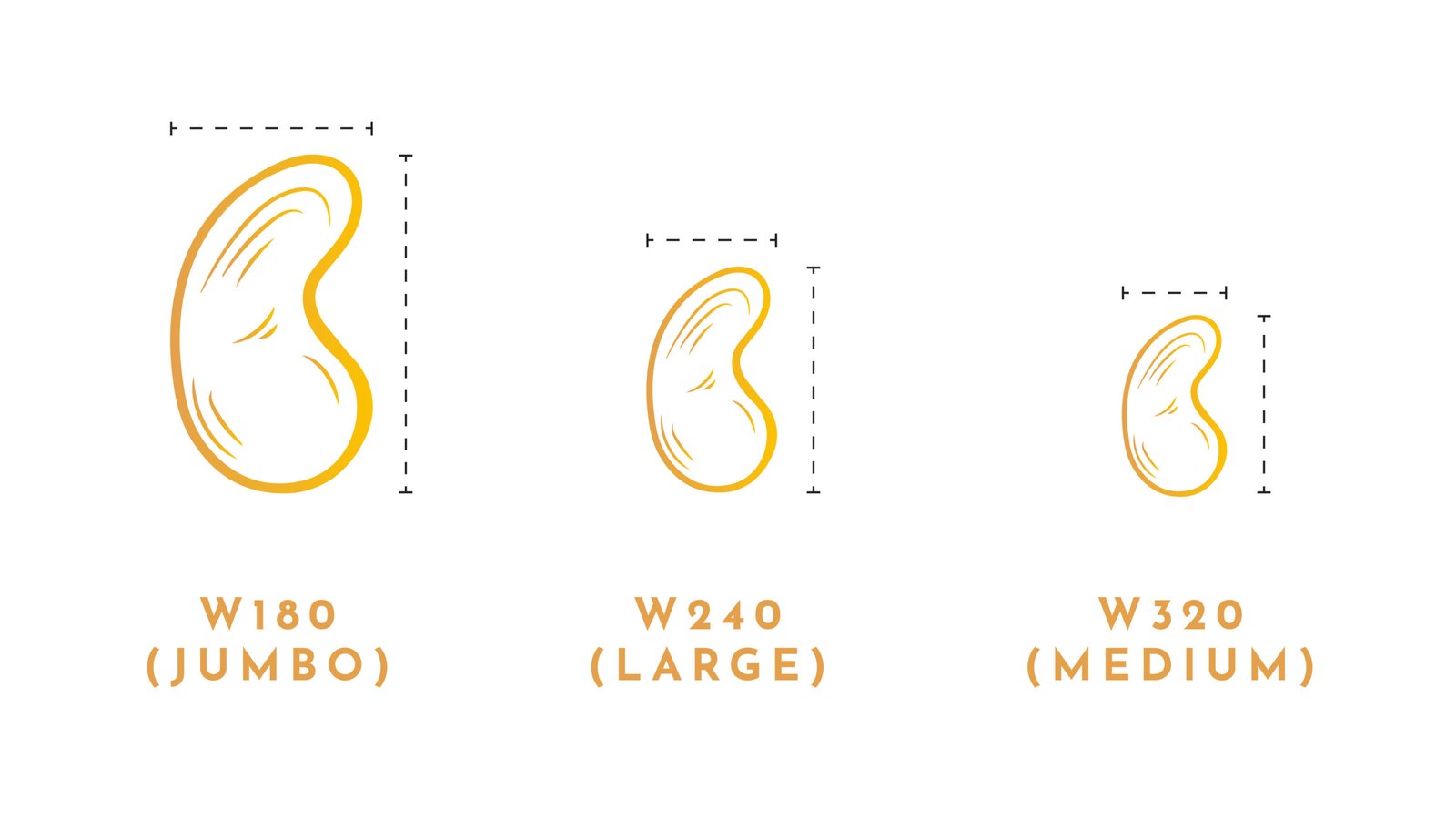
Walk into any store and you will see cashews sold as W180, W240, or W320, often at very different prices for what looks like the same nut. Those codes are cashew grades, and understanding them takes about two minutes. This guide explains what the numbers mean, what actually changes between grades (less than you think), what does not change (more than you think), and exactly which grade to buy for snacking, gifting, cooking, and sweets.
What do cashew grade numbers mean?
Cashew grading is an international standard used by processors and exporters. Each grade has two parts:
The letter. W means whole kernels. There are other letters you will see in wholesale markets: B for broken, S for splits, LWP and SWP for large and small white pieces. Everything Cube Root sells is W grade: whole, intact kernels only.
The number. This is the count of kernels per pound (454g). W180 means roughly 180 kernels per pound. Because the weight is fixed, a lower count means each individual kernel is bigger.
| Grade | Kernels per pound (±5%) | Kernels per kg (±5%) | Size |
|---|---|---|---|
| W180 | ~180 | ~397 | Jumbo, the largest standard grade |
| W240 | ~240 | ~530 | Large |
| W320 | ~320 | ~706 | Medium, the most common grade worldwide |
There are other whole grades (W210, W450) but W180, W240, and W320 cover almost everything sold retail in India.
What the grade number really changes?
The grade tells you the size of the kernel, and size is what shapes the eating experience.
- Bite and texture. A W180 is a full, two-bite kernel with a creamy, substantial chew. A W320 is a standard single bite. The bigger the kernel, the more satisfying the cashew feels in hand and mouth, which is why the largest grades headline gift boxes and premium counters.
- Rarity and price. Only a small fraction of any harvest grows large enough to grade as W180. Price follows scarcity: the bigger the kernel, the more premium the grade.
- The right job. Big kernels shine when eaten whole. Medium kernels make sense when the cashew is chopped, ground, or blended into a dish.
What matters just as much as grade, and varies between brands rather than between grades: harvest freshness, how the kernels were dried and stored, whether old stock is mixed in, and how they are packed. A fresh kernel of any grade beats a stale one every single time, which is why we vacuum pack everything. Here is how to judge cashew quality yourself, from any brand.
W180: The Jumbo Grade
W180 is the largest standard cashew grade, around 397 kernels per kilogram give or take 5%, and it is the grade Cube Root is built around. It is called the King of Cashews for a reason: this is the cashew at its fullest, a kernel with real presence and the creamiest bite the harvest can produce.
Buy W180 when:
- You want maximum bite. For pure snacking indulgence, nothing in the cashew world matches it.
- You are gifting. Corporate gifts, festive hampers, wedding favours. The first thing anyone notices about a cashew is its size.
- You serve guests. A bowl of jumbo cashews reads as premium before anyone tastes one.
Cube Root sells W180 in a 1kg airtight container, a 500g airtight container, and a 400g special edition metal tin built for gifting. (Shop: W180 Jumbo Cashews)
W240: The Large All-rounder
W240 runs about 530 kernels per kilogram give or take 5%, clearly larger than W320 but priced meaningfully below jumbo. It is the grade for people who want a big cashew without the collector-item pricing
Buy W240 when:
- You snack daily and want cashews at a sustainable price.
- You are making a trail mix or dry-fruit box.
- You want one grade that covers both the snack bowl and the occasional recipe.
W240 is versatile: big enough to impress in a bowl, economical enough to cook with when needed. Cube Root sells W240 in 1kg, 500g, and 200g packs. (Shop now: W240 Large Cashews)
W320: The Kitchen Workhorse
W320, at roughly 706 kernels per kilogram give or take 5%, is the most widely traded cashew grade on the planet. It is the practical grade: whole-kernel quality at the friendliest price per kilo, sized right for dishes where cashews get chopped, ground, or blended.
Buy W320 when:
- You cook with cashews. Kaju katli, cashew paste for gravies, korma bases, halwa, baking. The kernels get ground or chopped, so size is irrelevant.
- You snack in quantity. A household that goes through cashews weekly.
- You top breakfast bowls, oatmeal, or salads where a medium kernel is actually the better fit.
For cooking, W320 is the rational buy: the kernel disappears into the dish, so you keep the budget for quantity. For snacking whole, most cashew lovers find the step up to W240 or W180 worth every rupee.(Shop Now: W320 Medium Cashews)
Quick decision guide
| Your use | Best grade | Why |
|---|---|---|
| Gifting and festivals | W180 | Size is visible; the packaging makes it effortless for Gifting |
| Serving guests | W180 or W240 | Presentation matters |
| Daily snacking | W180 or W240 | Eat whole, so size is the experience |
| Trail mix and dry-fruit boxes | W240 | Stands out among other nuts |
| Kaju katli and sweets | W320 | Gets ground anyway; save the premium |
| Cashew paste and gravies | W320 | Blended; size irrelevant |
| Baking | W320 | Chopped; size irrelevant |
| First Cube Root order | W180 | Start with our signature grade |
Why freshness beats grade
Grade tells you how a cashew looks. Freshness decides how it tastes. Cashews are high in natural oils, and those oils slowly oxidise once the kernel is exposed to air, which is what makes old cashews taste flat or faintly bitter.
This is why Cube Root vacuum packs every 500g and 1kg container and never ships old stock: the kernels are graded, packed airtight, and sent out fresh rather than sitting in open sacks. Whatever grade you choose, it arrives tasting the way a cashew is supposed to. You can read the full journey from orchard to doorstep in our story post. (How we make your Cashews? (A Short Story))
Once opened, store cashews in an airtight container away from heat and light; refrigeration extends their life further. Our storage guide covers this in detail. (How to store your Cashews?)
FAQs
Which cashew grade is the best?
For eating whole, W180 is the pinnacle: the largest, rarest kernels with the fullest bite, which is why it is called the King of Cashews. W240 offers a large kernel at an everyday price, and W320 is the practical grade for cooking.
What does the W mean in cashew grades?
W stands for whole kernel. The number after it is the kernel count per pound: W180 has about 180 kernels per pound, W320 about 320. Lower numbers mean bigger cashews.
Do bigger cashews taste better?
Bigger kernels deliver a fuller, creamier bite and a more satisfying crunch, which is why the largest grades are the premium ones. For dishes where cashews are ground or blended, kernel size stops mattering and W320 is the sensible pick
Which cashew grade is best for kaju katli?
W320. The cashews are ground into flour, so kernel size is irrelevant and the lower price per kilogram makes W320 the sensible choice.
Why is there a price difference between W180 and W320?
Rarity. Only a small portion of each harvest grows large enough to grade as W180, so the largest kernels are the scarcest and most premium. W320 kernels are far more plentiful, which keeps their price friendly.
Are Cube Root cashews raw or roasted?
Plain and natural: not roasted, not salted, with no preservatives. They can be eaten as they are or roasted and seasoned at home.
Now that you can read a cashew label, choose the grade that fits how you will eat them: W180 for the full experience, W240 for every day, W320 for the kitchen. Browse all grades and pack sizes at our shop.
Deciding between just these two? See our full W240 vs W320 comparison.